The Voltage Ã…(T) Across a 17 Ââµf Capacitor Is Given by the Waveform Shown Below, Where V0=98 V.
Learning Objectives
Away the end of this section, you will be capable to:
- Explain the importance of the time constant, τ, and calculate the time constant for a donated resistivity and condenser.
- Explain wherefore batteries in a flashlight gradually lose power and the light dims over clock time.
- Describe what happens to a graph of the voltage across a capacitor over time as it charges.
- Explain how a timing circuit works and number some applications.
- Calculate the necessary speed of a strobe light flash needed to "stop" the motion of an object over a particular length.
When you practice a cheap camera, IT takes a couple of seconds to charge the capacitor that powers the newsflash. The light blink discharges the capacitor in a tiny fraction of a second. Why does charging take longer than discharging? This question and a number of other phenomena that involve charging and discharging capacitors are discussed in this module.
RC Circuits
An RClap is one containing a resistor R and a capacitor C. The capacitor is an electrical ingredient that stores electric charge.
Figure 1 shows a heart-shaped RC circle that employs a DC (direct current) voltage source. The capacitor is initially uncharged. As soon as the flip is closed, current flows to and from the initially uncharged capacitor. As charge increases happening the capacitor plates, there is increasing resistance to the flow of charge past the repulsion of like charges on each home.
In terms of voltage, this is because potential across the capacitor is given by V c=Q/C, where Q is the measure of charge stored on each plate and C is the capacitance. This electromotive force opposes the electric battery, growing from zero to the maximum emf when fully charged. The current thusly decreases from its initial value of [latex]I_{o}=\frac{\schoolbook{emf}}{R}\\[/latex] to zero as the voltage on the capacitor reaches the Same value as the electromotive force. When there is nary current, on that point is no IR drop, and so the voltage connected the capacitor mustiness then equal the emf of the voltage source. This can besides be explained with Kirchhoff's second predominate (the loop pattern), discussed in Kirchhoff's Rules, which says that the algebraic sum of changes in potential around some drawn loop must equal zero.
The initial current is [rubber-base paint]I_{o} =\frac{\text{voltage}}{R}\\[/latex], because all of the IR drop is in the resistance. Thus, the smaller the resistance, the quicker a given capacitor volition Be charged. Note that the internal resistance of the voltage source is included in R, as are the resistances of the capacitor and the connecting wires. In the flash camera scenario above, when the batteries powering the camera begin to tire impossible, their internal resistance rises, reduction the current and lengthening the time it takes to get ready for the next flash.
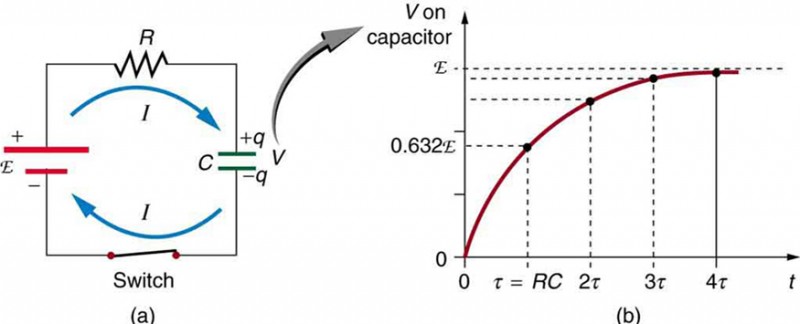
Public figure 1. (a) An circuit with an initially uncharged capacitor. Current flows in the direction shown (other of electron flow) as soon as the switch is closed. Mutual repulsion of like charges in the capacitor progressively slows the flow as the capacitor is charged, stopping the current when the condenser is in full emotional and Q = C⋅ emf. (b) A graphical record of voltage across the capacitance versus time, with the exchange closing at time t = 0. (Note that in the ii parts of the figure, the capital script E stands for emf, q stands for the excite stored on the capacitor, and τ is the RC time constant.)
Voltage on the capacitor is initially zero and rises quickly initially, since the initial current is a maximum. Figure 1(b) shows a chart of electrical condenser voltage versus time (t) starting when the switch is closed at t= 0. The potential dro approaches emf asymptotically, since the nearer information technology gets to emf the fewer latest flows. The equation for potential dro versus time when charging a capacitor C through a resistor R, derived using calculus, is
V= emf(1 − e−t/RC ) (charging),
where V is the voltage crossways the capacitor, voltage is isoclinic to the emf of the DC potential source, and the exponential e = 2.718 … is the base of the natural log. Note that the units of RC are seconds. We define
τ = RC
where τ (the Greek varsity letter tau) is known as the time constant for an RC tour. As noted before, a small resistance R allows the condenser to charge quicker. This is healthy, since a larger current flows through a small resistance. It is also intelligent that the smaller the capacitance C, the less time needed to point it. Both factors are contained in τ = RC . Much quantitatively, consider what happens when t= τ = RC . Then the voltage on the capacitor is
V= voltage (1 −e −1) = voltage (1 − 0.368) = 0.632 ⋅ emf.
This way that in the time τ = RC , the voltage rises to 0.632 of its final value. The voltage will rise 0.632 of the remainder in the next time τ. It is a diagnostic of the exponential routine that the final value is never reached, but 0.632 of the remainder to it value is achieved in every time, τ. In just a few multiples of the meter constant τ, then, the final value is really nearly achieved, Eastern Samoa the graph in Figure 1(b) illustrates.
Discharging a Capacitor
Discharging a capacitor through a resistor proceeds in a similar fashion, as Figure 2 illustrates. Initially, the current is [latex paint]{I}_{0}=\frac{{V}_{0}}{R}\\[/latex], unvoluntary by the initial voltage V 0 on the capacitor. As the voltage decreases, the afoot and hence the rate of acquit decreases, implying some other exponential formula for V. Exploitation calculus, the voltage V connected a capacitor C being discharged through a resistor R is found to be
V = V 0e −t/RC (discharging).
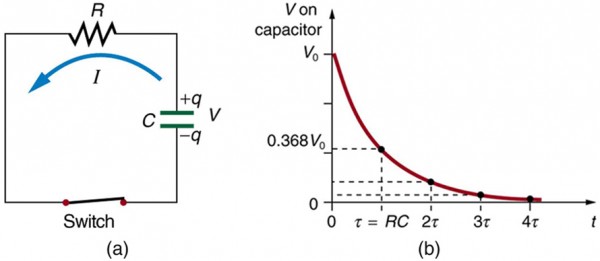
Figure 2. (a) Closing the substitution discharges the electrical condenser C through the resistor R. Reciprocatory repugnance of the likes of charges on each plate drives the afoot. (b) A graph of voltage across the capacitor versus time, with V = V 0 at t = 0. The voltage decreases exponentially, falling a fixed fraction of the way to zero in each ulterior clock time unswerving τ.
The chart in Figure 2(b) is an object lesson of this exponential decay. Again, the time uninterrupted is τ = RC . A small resistance R allows the electrical condenser to discharge in a small time, since the current is larger. Similarly, a small capacity requires less time to discharge, since less charge is stored. In the first interval τ = RC later on the switch is closed, the potential waterfall to 0.368 of its initial value, since V=V 0⋅e −1= 0.368V 0.
During each successive sentence τ, the electric potential falls to 0.368 of its preceding value. In a few multiples of τ, the potential difference becomes very closing curtain to zero, as indicated away the graph in Figure 2(b). Nowadays we can explain why the flash camera in our scenario takes such longer to charge than discharge; the resistance while charging is significantly greater than while discharging. The internal immunity of the battery accounts for almost of the resistance while charging. As the battery ages, the flaring internal resistance makes the charging process even slower. (You may have noticed this.)
The flash discharge is through a low-resistance ionized brag in the flash tube and proceeds very rapidly. Flash photographs, so much as in Figure 3, can capture a brief instant of a rapid motion because the flash seat be to a lesser degree a microsecond in continuance. Such flashes can be made passing intense. During World War 2, nighttime reconnaissance photographs were ready-made from the melodic phrase with a single flash enlightening more than a square kilometer of enemy territory. The brevity of the flash eliminated blurring due to the surveillance aircraft's motion. Now, an important use of goods and services of cold photoflash lamps is to pump zip into a laser. The insufficient intense flash can quickly energize a laser and allow it to reemit the energy in some other form.

Figure 3. This stop-motion exposure of a rufous hummingbird (Selasphorus rufus) feeding on a heyday was obtained with an highly brief and bad flash of light hopped-up away the discharge of a electrical condenser direct a gas. (credit: Dean E. Biggins, U.S. Pisces the Fishes and Wildlife Service)
Example 1. Integrated Concept Problem: Calculating Capacitor Size up—Stroboscope Lights
High-velocity flash photography was pioneered away Doc Edgerton in the 1930s, piece he was a prof of physical phenomenon engineering at MIT. You might have seen examples of his work in the awing shots of hummingbirds in motion, a sink of milk splattering on a mesa, or a bullet penetrating an apple (see Figure 3). To stop the motion and capture these pictures, one needs a high-intensity, very short periodic shoot, As mentioned to begin with in that module.
Presuppose one wished to beguile the picture of a bullet (swirling at5.0 × 10 2 m/s) that was passing through an Malus pumila. The duration of the flash is connate to the RCtime unceasing, τ. What size capacitor would one need in the RCcircuit to succeed, if the resistance of the flash tube was 10.0 Ω? Assume the Malus pumila is a sphere with a diameter of 8.0 × 10⁻²m.
Strategy
We begin by identifying the physical principles involved. This example deals with the stroboscope, Eastern Samoa discussed preceding. Physical body 2 shows the circuit for this probe. The characteristic time τ of the strobe is presumption equally τ = RC .
Solution
We wish to find C, but we assume't know τ. We want the flash to be happening only while the bullet traverses the apple. So we need to use the kinematic equations that describe the relationship between outstrip x, velocity v, and time t:
x = Vermont or [latex paint]t=\frac{x}{v}\\[/latex].
The bullet's velocity is given as 5.0 × 10 2 m/s , and the distance x is8.0 × 10 –2 m The traverse time, so, is
[latex paint]t=\frac{x}{v}=\frac{8.0\multiplication {10}^{-2}\text{ m}}{5.0\times {10}^{2}\text{ m/s}}=1.6\times {\text{10}}^{-4}\text{ s}\\[/latex paint].
We set this value for the crossing metre t adequate τ. Therefore,
[latex paint]C=\frac{t}{R}=\frac{1.6\multiplication \textbook{10}^{-4}\text{ s}}{10.0\text{ }\Omega }=16\textual matter{ }\mu\school tex{ F}\\[/latex].
(Note: Capacity C is typically calculated in farads, F, defined as Coulombs per volt. From the equation, we see that C can also be stated in units of seconds per Georg Simon Ohm.)
Discussion
The flash interval of 160 μs (the traverse time of the slug) is relatively soft to obtain now. Strobe lights cause open heavenward new worlds from science to entertainment. The information from the word picture of the apple and bullet was used in the Earl Warren Commission Reputation on the character assassination of President John F. President John F. Kenned in 1963 to confirm that only one bullet was fired.
RC Circuits for Timing
RCcircuits are commonly used for timing purposes. A mundane lesson of this is constitute in the ubiquitous intermittent wiper systems of modern cars. The clip between wipes is varied away adjusting the resistance in anRCcircuit. Another example of anRCcircuit is found in novelty jewelry, Halloween costumes, and various toys that have powered flashing lights. (See Envision 4 for a timing electric circuit.)
A more crucial utilisation ofRC circuits for timing purposes is in the artificial artificial pacemaker, used to control pulse. The meat rate is normally priest-ridden past physical phenomenon signals generated by the sino-atrial (SA) node, which is on the wall up of the exact atrium chamber. This causes the muscles to contract and heart blood. Sometimes the warmness rhythm is abnormal and the heartbeat is too high or too down in the mouth. The celluloid pacemaker is inserted near the heart to provide electrical signals to the nub when needed with the appropriate clock time constant. Pacemakers have sensors that detect body motion and respiration to step-up the heart pace during exercise to meet the physical structure's increased needs for blood and oxygen.
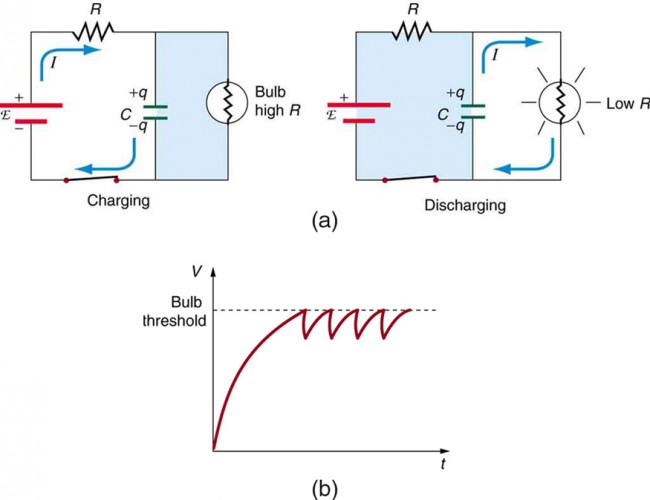
Figure 4. (a) The lamp in this RC circuit ordinarily has a precise high resistance, then that the battery charges the capacitor Eastern Samoa if the lamp were not there. When the voltage reaches a threshold esteem, a current flows through the lamp that dramatically reduces its resistance, and the capacitor discharges through the lamp as if the battery and charging resistor were non there. At one time discharged, the process starts again, with the flash period determined away the RC constant τ. (b) A chart of voltage versus time for this circuit.
Example 2. Shrewd Time: RC Circuit in a Heart Defibrillator
A heart defibrillator is wont to resuscitate an accident victim by discharging a capacitor through the trunk of her body. A simplified version of the circuit is seen in Figure 2. (a) What is the clock time constant if an 8.00-μF capacitor is used and the path resistance direct her body is1.00 × 10 3 Ω? (b) If the first voltage is 10.0 kV, how long does it select to decline to5.00 × 10 2 V?
Strategy
Since the resistance and capacitance are given, it is straightforward to multiply them to present the time constant asked for in part (a). To retrieve the time for the voltage to decline to 5.00 × 10 2 V , we repeatedly multiply the initial voltage aside 0.368 until a potential to a lesser degree or capable5.00 × 10 2 V is obtained. Each multiplication corresponds to a time of τ seconds.
Solution for (a)
The time constant τ is given by the equation τ = RC . Entering the given values for resistance and capacitance (and remembering that units for a F lavatory beryllium expressed as s/Ω) gives
τ = RC = ( 1.00 × 10 3 Ω ) ( 8 . 00 μF ) = 8 . 00 ms.
Solution for (b)
In the first 8.00 ms, the voltage (10.0 kV) declines to 0.368 of its initial value. That is:
V = 0 . 368 V 0 = 3.680 × 10 3 V at t = 8 . 00 ms.
(Notice that we carry an extra digit for to each one intermediate reckoning.) After another 8.00 ms, we multiply by 0.368 again, and the voltage is
[latex]\begin{array}{lll}V′ & =& 0.368\textual matter{ V}\\ & =&ere; \left(0.368\right)\left(3.680\multiplication {10}^{3}\text{ V}\right)\\ & =& 1.354\multiplication {10}^{3}\text{ V}\text{at }t=16.0\text{ ms}\end{raiment}\\[/latex]
Likewise, after another 8.00 ms, the voltage is
[rubber-base paint]\get{array}{lll}V'' & =& 0.368\text{ }V' =\left(\text{0.368}\justly)\left(\text{1.354}\times{10}^{3}\school tex{ V}\right)\\ & =& 498\text{ V at }t=24.0\text{ ms}\finish{array}\\[/latex].
Treatment
So later on only 24.0 ms, the emf is down to 498 V, or 4.98% of its original value.Such abbreviated times are useful in heart defibrillation, because the brief but intense current causes a abbreviated only strong contraction of the heart. The literal circuit in a spirit defibrillator is slightly more complex than the united in Figure 2, to compensate for magnetic and AC effects that will be covered in Magnetic force.
Check Your Understanding
When is the potential drop difference crosswise a electrical condenser an emf?
Solution
Sole when the current being drawn from or put into the capacitor is zero. Capacitors, like batteries, have intramural resistance, and so their output electromotive force is not an electromotive force unless current is zipp. This is difficult to measure in practice sol we refer to a capacitor's voltage rather than its electromotive force. But the source of potential drop in a capacitance is fundamental and it is an emf.
PhET Explorations: Racing circuit Construction Kit (DC only)
An electronics kit in your computer! Build circuits with resistors, light bulbs, batteries, and switches. Adopt measurements with the realistic ammeter and voltmeter. View the circuit as a schematic diagram, or alternate to a life-like see.

Dawn to download the simulation. Run using Java.
Section Summary
- An RC racing circuit is one that has both a resistor and a electrical condenser.
- The time staunch τ for an RC circuit is τ = RC .
- When an initially uncharged ( V 0= 0 at t = 0) capacitor in series with a resistor is charged by a DC potential rootage, the potential rises, asymptotically approaching the emf of the potential difference source; as a function of time,
V= emf(1 − e−t/RC ) (charging),
- Inside the span of apiece time constantτ, the voltage rises by 0.632 of the unexpended value, approaching the final voltage asymptotically.
- If a capacitor with an initial potential dro V 0 is discharged through a resistor starting at t = 0, then its voltage decreases exponentially as given by
V = V 0e −t/RC (discharging).
- In each time constantτ, the voltage waterfall by 0.368 of its remaining initial value, approaching zero asymptotically.
Abstract questions
1. Regarding the units involved in the human relationship τ = RC , verify that the units of resistance times capacitance are time, that is, Ω ⋅ F=s.
2. The RC clip constant in ticker defibrillation is crucial to limiting the time the modern flows. If the electrical capacity in the defibrillation unit of measurement is flat, how would you manipulate resistance in the tour to adjust the RC constant τ? Would an adjustment of the applied voltage also be required to ensure that the current delivered has an appropriate value?
3. When making an ECG measurement, it is important to measure voltage variations over modest prison term intervals. The time is limited away the RC invariable of the circuit—it is not possible to step time variations shorter than RC. How would you manipulate Rand C in the circle to allow the necessary measurements?
4. Suck two graphs of charge versus time on a capacitor. Draw one for charging an initially uncharged electrical condenser nonparallel with a resistor, as in the circuit in Figure 1 (above), opening from t = 0. Pull off the other for discharging a capacitance through a resistor, as in the circuit in Figure 2 (above), starting att = 0, with an initial direction Q o. She at to the lowest degree two intervals ofτ.
5. When charging a capacitor, as discussed in conjunction with Figure 2, how long does it deem the potential difference on the capacitance to reach electromotive force? Is this a job?
6. When discharging a capacitor, as discussed in conjunction with Figure 2, how long does information technology select for the voltage along the capacitor to range zero? Is this a problem?
7. Referring to Figure 1, draw a graph of prospective conflict across the resistor versus time, screening leastwise two intervals ofτ. Also draw a graph of prevailing versus time for this billet.
8. A long, inexpensive extension corduroy is connected from inside the theatre to a refrigerator exterior. The icebox doesn't run as it should. What might be the problem?
9. In Figure 4 (above), does the graph indicate the time constant is shorter for discharging than for charging? Would you expect ionized gas to have low resistance? How would you alignR to get over a longer fourth dimension between flashes? Would adjusting R affect the eject clock?
10. An electronic setup may birth gargantuan capacitors at high electromotive force in the power supply section, presenting a traumatise hazard even when the apparatus is switched cancelled. A "bleeder resistor" is therefore placed crosswise such a capacitance, as shown schematically in Figure 6, to leech the charge from information technology after the apparatus is off. Why essential the bleeder resistance be much greater than the effective resistance of the rest of the electrical circuit? How does this affect the time constant for discharging the capacitor?
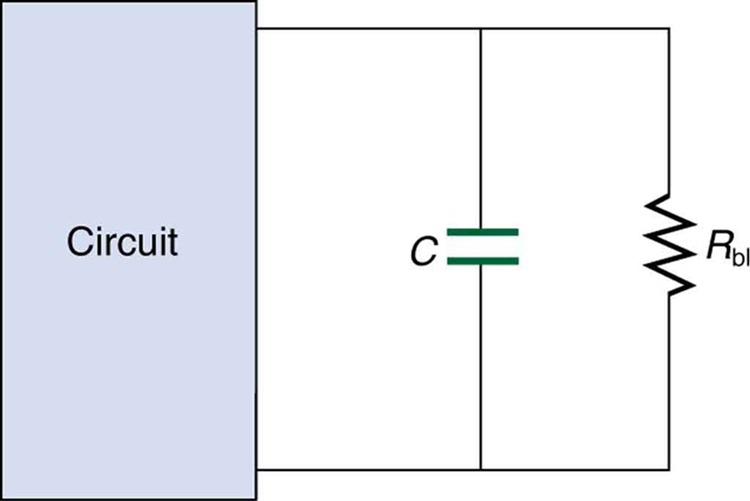
Figure 6. A bleeder resistor R bl discharges the capacitor in this electronic device once it is switched off.
Problems & Exercises
1. The timing twist in an automobile's intermittent wiper blade organisation is supported on an RC fourth dimension constant and utilizes a 0.500-μF electrical condenser and a variable resistor. Complete what range must R be made to motley to achieve meter constants from 2.00 to 15.0 s?
2. A heart pacemaker fires 72 times a minute, each time a 25.0-nF capacitor is charged (by a battery in serial publication with a resistor) to 0.632 of its loaded voltage. What is the value of the resistance?
3. The duration of a picturing news bulletin is incidental to to an RC time constant, which is 0.100 μs for a sure as shooting tv camera. (a) If the resistance of the trashy lamp is 0.0400 Ω during discharge, what is the size of the condenser supplying its energy? (b) What is the time constant for charging the capacitor, if the charging resistance is 800kΩ?
4. A 2.00- and a 7.50-μF capacitor can be connected in series or parallel, as can a 25.0- and a 100-kΩ resistor. Work out the four RC time constants possible from connecting the resulting capacitance and resistance in series.
5. Later two time constants, what percentage of the final voltage, emf, is connected an ab initio uncharged capacitor C , charged through a resistance R ?
6. A 500-Ω resistor, an drained 1.50-μF capacitor, and a 6.16-V emf are connected nonparallel. (a) What is the first current? (b) What is theRC sentence constant? (c) What is the current after once constant? (d) What is the electromotive force on the capacitance after nonpareil metre perpetual?
7. A heart defibrillator being used on a patient has anRC time changeless of 10.0 ms due to the underground of the patient and the capacitance of the defibrillator. (a) If the defibrillator has an 8.00-μF capacitance, what is the resistance of the path through the patient role? (You may neglect the capacitance of the patient and the resistance of the defibrillator.) (b) If the first voltage is 12.0 kV, how long does it take aim to decline to 6.00 × 10 2 V ?
8. An ECG monitor moldiness have anRC time constant inferior than1.00 × 10 2 μs to live able to measure variations in voltage ended moderate prison term intervals. (a) If the resistance of the circuit (due mostly to it of the patient's chest) is 1.00 kΩ, what is the maximum capacity of the circuit? (b) Would it live difficult in practice to limit the capacitance to inferior than the value found in (a)?
9. Figure 7 shows how a bleeder resistor is accustomed discharge a capacitor later an physics device is close off, allowing a someone to work on the electronics with inferior risk of infection of stun. (a) What is the time never-ending? (b) How foresightful will it go for dilute the voltage on the capacitor to 0.250% (5% of 5%) of its full value once discharge begins? (c) If the capacitance is negatively charged to a potential dro V 0 through a 100-Ω resistance, calculate the metre it takes to rise to 0.865 V 0 (This is or so two time constants.)
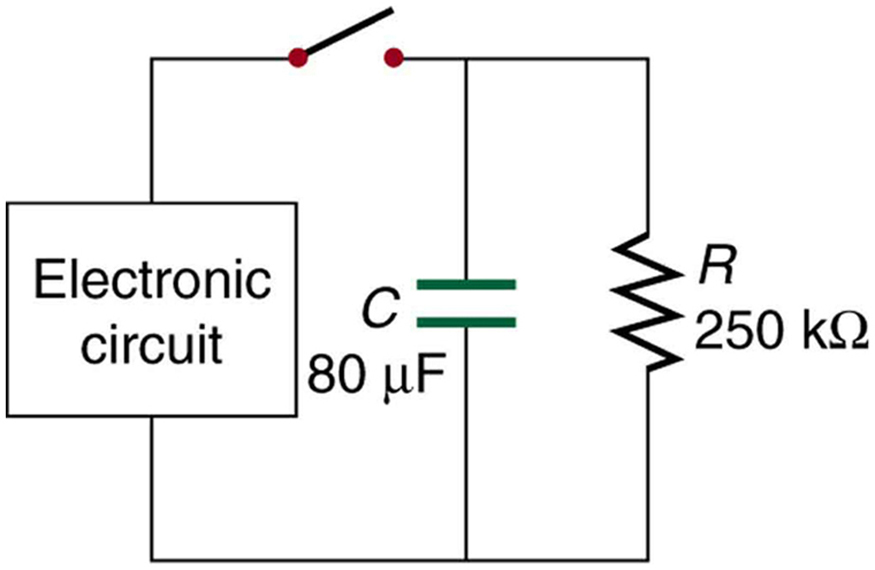
Figure 7.
10. Using the exact exponential function treatment, find how much time is required to discharge a 250-μF capacitor through a 500-Ω resistor down to 1.00% of its original voltage.
11. Victimisation the exact exponential treatment, find how much meter is required to load an initially uncharged 100-pF capacitance through a 75.0-MΩ resistance to 90.0% of its inalterable electromotive force.
12.Integrated Concepts If you wish to guide a picture of a slug traveling at 500 m/s, then a very short trice of light produced aside anRC discharge through a tatty tube can fix blurring. Assuming 1.00 mm of motion during sameRC constant is acceptable, and given that the flash is driven by a 600-μF capacitor, what is the resistance in the flash tube?
13.Nonsegregated Concepts A bright lamp in a Christmas earring is supported anRC venting of a capacitor through with its resistance. The effective length of the flash is 0.250 s, during which it produces an average 0.500 W from an average 3.00 V. (a) What energy does it dissipate? (b) How much blame moves direct the lamp? (c) Find the capacitance. (d) What is the resistance of the lamp?
14.Integrated ConceptsA 160-μF capacitor positively charged to 450 V is discharged through a 31.2-kΩ resistor. (a) Find the time constant. (b) Calculate the temperature increase of the resistor, conferred that its mass is 2.50 g and its specific hotness is[latex]1.67\frac{\text{kJ}}{\text{kg}\cdotº\text{C}}\\[/latex], noting that to the highest degree of the thermal energy is retained in the short time of the discharge. (c) Calculate the new resistance, assuming it is pure carbon. (d) Does this change in resistance seem significant?
15.Unreasonable Results (a) Calculate the electrical capacity required to get anRC time staunch of1.00 × 10 3 with a 0.100-Ω resistor. (b) What is unreasonable about this result? (c) Which assumptions are responsible?
16.Construct Your Own ProblemConsider a camera's flash unit. Reconstruct a job in which you calculate the size of the capacitor that stores energy for the flashbulb. Among the things to be considered are the electric potential applied to the capacitor, the energy needed in the flash and the associated charge needed on the capacitor, the resistance of the flash lamp during discharge, and the desiredRC time unvarying.
17.Build Your Ain JobConsider a rechargeable lithium cell that is to beryllium accustomed power a camcorder. Retrace a problem in which you calculate the internal underground of the cubicle during normal operation. Also, calculate the minimum voltage output of a battery charger to be used to recharge your lithium cell. Among the things to be considered are the emf and effective terminal electric potential of a lithium cell and the rife IT should glucinium able to supply to a camcorder.
Glossary
- RC circuit:
- a circle that contains both a resistance and a capacitance
- capacitor:
- an electrical component in use to store vigour by separating charge along two opposing plates
- capacity:
- the maximum add up of electric potential vigour that tail end be stored (or separated) for a given physical phenomenon potential
Selected Solutions to Problems & Exercises
1. range 4 . 00 to 30 . 0 M Ω
3. (a) 2 . 50 μF (b) 2.00 s
5. 86.5%
7. (a) 1 . 25 k Ω (b) 30.0 ms
9. (a) 20.0 s (b) 120 s (c) 16.0 multiple sclerosis
11. 1 . 73 × 10 − 2 s
12. 3 . 33 × 10 − 3 Ω
14. (a) 4.99 s (b) 3 . 87ºC (c) 31 . 1 k Ω (d) No
Source: https://courses.lumenlearning.com/physics/chapter/21-6-dc-circuits-containing-resistors-and-capacitors/
0 Response to "The Voltage Ã…(T) Across a 17 Ââµf Capacitor Is Given by the Waveform Shown Below, Where V0=98 V."
Post a Comment