Is a Sprained Ankle Likely to Happen Again
Continuing Education Activeness
Ankle sprains are 1 of the most common recurrent injuries of the lower extremity. Upward to twoscore% of ankle sprains continue to develop chronic symptoms, including pain, swelling, instability, and recurrence that persists at to the lowest degree 12 months mail-injury. This activity outlines the evaluation, treatment, and management of recurrent ankle sprains. Too as, reviews the role of healthcare provider facilitating the proper treatment programme for patients with this condition.
Objectives:
-
Place the pathophysiology of recurrent ankle sprains.
-
Review the epidemiology of recurrent ankle sprains.
-
Outline the management options available for recurrent ankle sprains.
-
Summarize some interprofessional team strategies for improving intendance coordination and communication to accelerate recurrent ankle sprains and improve outcomes.
Admission free multiple choice questions on this topic.
Introduction
Ankle sprains are among the most mutual recurrent injuries of the lower extremity. Up to twoscore% of ankle sprains go on to develop chronic symptoms, including pain, swelling, instability, and recurrence that persists at least 12 months post-injury.[1] Furthermore, approximately 20% of individuals who sustain astute sprain develop into chronic ankle instability.[2] Ankle sprains are common amongst the general population and athletic population akin. The theory is that the resulting impairment of proprioception predisposes the private to recurrence; thus, a thorough history and evaluation tin can direct practitioners when evaluating recurrent ankle instability to decrease the likelihood of further complications.
Etiology
Recurrent talocrural joint sprains are multifactorial injuries, with index (first-fourth dimension) talocrural joint sprain being predictive of recurrent ankle sprains in up to 61% of those injured. The about mutual mechanism of injury for a lateral ankle sprain includes inversion with adduction, as the body asserts force over the foot. This injury most ordinarily affects the anterior talofibular ligament (ATFL). During an index talocrural joint sprain, the ligaments of the talocrural joint undergo microscopic tears due to the stress practical, resulting in attenuation. Factors associated with recurrent ankle sprains include:
-
Diminished postural control
-
Impaired proprioception
-
Loss of muscle forcefulness [3]
-
Ligamentous laxity (i.east., Ehlers-Danlos syndrome, Marfan syndrome, and Turner's syndrome)
-
Decreased talocrural joint articulation range of motion
-
Cavus foot-type
An damage in the baseline, or pre-injury, level of proprioception in an injured private pre-dispose the ankle to re-injury. Injury prevention relies on factors such as talocrural joint articulation stability. It is heavily dependent on the body'southward power to self-assess internal kinesthetics regarding the position and movement of the ankle articulation. Passive and dynamic restraints, such as the joint capsule and muscles, respectively, are weakened, increasing the hazard of recurrence.[four]
Epidemiology
Approximately 2 million acute ankle sprains are reported annually in the United States.[v] Ankle sprains account for ane of the most common reasons for emergency department and primary visit, following a lower leg injury. Approximately 2.15 per one thousand persons sustain an talocrural joint sprain in the Us, every bit reported by the emergency section.[6]
Age as a predictor of recurrent talocrural joint sprain has been inconsistent. The hateful historic period has been reported equally 26.20 years, according to the Waterman et al. written report in 2010, with peak incidence occurring between x and 19 years of age.[6] In the Pourkazemi et al. longitudinal written report, participants ranged in historic period between eighteen thru 60 years, with findings suggesting those under the age of 24 years were at college of incurring an ankle sprain.[three] Some other report reported, the incidence of talocrural joint sprain in adults as 0.72 per chiliad versus i.94 per 1000 for adolescents.[7] Overall, higher rates of ankle sprain reportedly occur in younger participants. This finding may be attributable to neurological development in conjunction with physical, cognitive, and social development.[8]
Co-ordinate to the Waterman et al. study, overall males had an incidence rate of 2.twenty, and females had an incidence rate of two.x, ankle sprains per 1000 person annually. Males between the age of 15 and twenty-four were more decumbent to this injury compared to females of the same age group. However, females between the historic period of thirty to ninety-9 incurred more ankle sprains than their male counterparts.
Regarding race, African Americans and Caucasians have substantially higher incidence when compared to Hispanics. Overall, African American males had a considerably higher incidence of ankle sprain when compared to Hispanic males.[6]
Nearly one-half of all ankle sprains were reported during some form of athletic activity, with basketball game, football, and soccer, existence 41.ane%, 9.three%, and 7.9%, respectively.[6]
Also, military service members reportedly incurred more ankle sprains when compared to the civilian population.[9]
Pathophysiology
After an index talocrural joint sprain, the microscopic tears due to the overstressing of the ankle ligaments can pb to attenuation. As a result, functional and mechanical instability may ensue, which increases the likelihood of recurrent talocrural joint sprain when proper handling is non applied. Equally previously mentioned, the ATFL is the nearly commonly injured talocrural joint ligament, followed by the calcaneofibular ligament (CFL), and then posterior talofibular ligament (PTFL).
Lateral ankle instability can be divers every bit either functional instability or mechanical instability. Diagnosis of which form of instability is imperative for proper treatment. Functional instability is chronic and is commonly described subjectively past the patient as the ankle "giving out" or "giving way." For this instability, dissimilar mechanical, there are no clinical or radiographic findings that would suggest instability. These patients typically encounter proprioceptive deficits secondary to ligamentous trauma.
Mechanical instability entails excessive motion in the ankle joint that tin exist assessed clinically by performing an anterior drawer sign or radiographically stressing the talocrural joint joint.
History and Physical
Clinical evaluation should include a detailed and systematic history, with the mechanism of injury described by the patient, if possible. The mechanism of injury of index ankle sprain should besides merit consideration to pinpoint previous ligamentous attenuation.
As with acute ankle sprain, recurrent ankle sprain concrete exam should exist thorough and get-go begin with ascertainment of whatever gross dislocation or asymmetry. Next, palpation of ankle ligaments should be conducted and evaluated for tenderness, including the medial ankle and length of the fibula.
-
Edema and ecchymosis may or may not be visually apparent during the fourth dimension of examination.
-
Assess the range of motion of the afflicted ankle joint, besides every bit comparing the contralateral ankle
-
-
Normal ankle dorsiflexion: 10 degrees (articulatio genus extended), 20 degrees (knee flexed)
-
-
Assess the range of motion of the subtalar joint, comparing to the contralateral subtalar articulation
-
Assess muscular strength, including plantarflexion, dorsiflexion, inversion and eversion
-
Assess neurovascular condition
Special tests tin serve to stress the ankle joint ligaments:
-
Inductive drawer test
-
-
Appraise ATFL integrity
-
Positive "dimple" sign
-
-
Talar tilt test
-
-
Assess subtalar instability and integrity of CFL
-
-
Kleiger external rotation test
-
-
Appraise possible deltoid ligament injury or ankle syndesmosis injury
-
Ankle sprain classification is as follows:
-
Form 1: Mild stretching of the lateral ligament complex with microscopic tearing, no joint instability. Balmy edema present with no functional loss or joint instability. The patient may exist able to fully or partially acquit weight.
-
Form II: Ligament tear or partial rupture (unremarkably of the ATFL). Moderate to severe edema, with ecchymosis. Moderate functional loss with balmy to moderate joint instability. The patient may feel difficulty weight-bearing.
-
Grade Three: Complete disruption/rupture of the ligament with moderate to severe instability of the ankle joint. Immediate edema with ecchymosis. Moderate to severe ankle joint instability.
Evaluation
Evidently films can be utilized to dominion out the possibility of acute fracture, which information shows only to be present in virtually fifteen% of all acute talocrural joint sprains. Radiographic moving picture serial should include weight-bearing views of A/P, mortise, and lateral. Talar stress views and external rotation stress views tin too exist diagnostically helpful; however, it may be unnecessary for the diagnosis of a lateral ankle sprain.
The Ottawa Ankle Rules should help guide efforts to limit radiation exposure to patients. Thus, radiographs are indicated based on the criteria beneath, involving the ability to comport weight immediately postal service-injury, as well as specific points of tenderness.
-
Pain in the malleolar zone with the inability to comport weight for four steps immediately and/or in the emergency department
-
Hurting in the malleolar zone with tenderness to palpation local to the posterior one-half (distal vi cm) of the fibula or tip of the lateral malleolus
-
Pain in the malleolar zone with tenderness to palpation local to the posterior half (distal half dozen cm) of the tibia or tip of the medial malleolus [10]
Magnetic resonance imaging (MRI) is particularly advantageous for assessing soft tissue injury in the talocrural joint region and is typically reserved for the planning of primary ligamentous surgical repair. Diagnosis criteria of acute ligamentous injury include morphologic and indicate intensity changes within and around the suspected ligament. Healthy ligaments of the ankle complex are seen as thin, linear, depression-signal intensity structures when uninjured. With an acute injury, intrasubstance edema can exist seen on fat-suppressed or T2-weighted imaging as increased signal intensity within the ligament. In contrast, chronic injury to the ligament volition show every bit thickening, elongation, and irregular contouring of the suspected ligament with no pregnant soft-tissue edema, marrow changes, or hemorrhaging noted by increased signal intensity. The ATFL, CFL, and PTFL are best viewed on coronal and axial views with the pes placed in dorsiflexion, and sectional thickness of three mm or less is recommended for the reliability of visualization.
Handling / Direction
Acute talocrural joint sprains mostly receive treatment with conservative measures, i.eastward., ankle brace, and rarely require surgical intervention. Nonetheless, recurrent talocrural joint sprains may crave surgical intervention if all bourgeois measures have been exhausted. Price therapy, formerly known as RICE therapy, involves protection, remainder, ice, compression, and meridian. There is no evidence regarding the effectiveness of this therapy; however, this intervention commonly assists with short term pain control to facilitate the early restoration of strength and range of motion.
Nonsteroidal anti-inflammatory drugs (NSAID), used topically or taken orally, can exist utilized in addition to PRICE therapy for brusque term symptomatic hurting control. Additionally, if fracture were to be present, contempo bear witness has suggested normal dosage NSAID use of fewer than 14 days does not increase the run a risk of nonunion, as previously documented.[xi]
Neuromuscular grooming therapy is imperative in reducing the recurrence rate and should be implemented to better overall functional instability. These exercises, which typically include proprioception tasks and balance, have been found to improve overall ankle functional outcomes significantly.[12] Examples of therapy include; balancing on a biomechanical ankle platform system (BAPS) or ankle disc, continuing on the injured leg while performing activities such as throwing or catching a ball and continuing on the injured leg with the eyes closed. A systematic review and meta-analysis of the effectiveness of proprioceptive training involving 3,726 participants revealed a significant reduction of injury when proprioceptive preparation was administered when compared to a control. Thus, a therapy plan involving proprioceptive training is highly effective at reducing the recurrence of ankle sprain among sporting populations.[13]
Although virtually experts recommend ii weeks of immobilization and protected weight-bearing, a brusque menstruation of immobilization, upwardly to 10 days, has been suggested by some investigators to be beneficial for the management of hurting control and edema.[14]
External support in the form of taping or bracing over rigid immobilization has proven to be more than constructive, every bit these therapies have constitute a greater reduction in edema and shorter time to return to sport. The application of a brace can besides exist beneficial for upward to i-yr post-injury. Bracing has shown effectiveness in prevention from recurrent injury simply has not shown to be effective equally a preventative therapy for the initial injury. At that place is a strong belief that caryatid application works by supporting impaired proprioception, as opposed to the range of motion restriction. Trending research supports bracing as superior to neuromuscular training regarding the prevention of self-reported recurrent ankle sprains, with a 47% reduction in recurrence versus neuromuscular therapy.[15]
Taping has also demonstrated effectiveness with the prevention of recurrent ankle sprain, with two to four-fold reduction, compared with no taping. However, the effects of taping vs. bracing are by and large inconclusive and more than preferential.[sixteen]
Differentiation betwixt mechanical instability versus functional instability is imperative for surgical option when warranted. Oft chronic, recurrent ankle sprains can atomic number 82 to chronic talocrural joint instability and pain that is unresolved by conservative measures.
The most common surgical process for recurrent ankle sprains with chronic lateral ankle instability is the Brostrom Gould procedure. During this procedure, non-absorbable or equivalent suture material tin can be utilized with one or two suture anchors to facilitate the repair of the anterior talofibular ligament. The calcaneofibular ligament can also exist augmented in the repair if injured.
Other surgical options include anatomical reconstructions with tendon grafting, such equally the Watson-Jones, Evans, and Chrisman-Snook. Yet, the previously mentioned procedures are not as normally performed. Furthermore, these procedures are more disruptive to the anatomy, more technically difficult, and are more than probable to consequence in ankle joint over-tightening.
Also, ankle arthroscopy is generally recommended with any procedure involving lateral ankle stabilization, as it is common for a patient to sustain other pathologies due to the machinery of injury. Other coexisting pathologies include; synovitis, anterior tibiotalar impingement, and osteochondral lesions. A study by Komenda and Ferkel institute 93% of the study's patients with chronic talocrural joint instability presented with intraarticular pathology, synovitis being the most common, followed past the presence of loose bodies.[17] Furthermore, another written report found the medial attribute of the ankle, involving the tibia and talus, had the highest incident of osteochondral lesions secondary to acute talocrural joint sprains.[18]
Differential Diagnosis
-
Ankle fracture
-
Posterior tibial tendonitis
-
Osteochondral lesion of the talus
-
Neuromuscular disorder
-
Superficial peroneal nerve neuralgia
-
Peroneal tendon tears
-
Anterior process of the calcaneus fracture
-
Base of the fifth metatarsal fracture
Prognosis
Upward to 85% of all injuries respond to conservative treatment; notwithstanding, upwards to 20% will keep to exist unstable, prompting the necessity of surgical intervention. The Brostrom with Gould modification surgical process has had upwardly to 95% documented success rate. This procedure has demonstrated the ability to improve the stability of the subtalar and ankle joint without compromising other healthy tendons of the ankle joint, such every bit the peroneus brevis in the Chrisman-Snook and Watson-Jones procedures.
Complications
An private is more likely to reinjure the same ankle later on sustaining an initial ankle sprain. Equally a upshot of recurrent injury, an private tin can develop chronic pain or instability, documented in twenty to l% of these cases.[sixteen]
Chronic ankle instability (CAI) is a well-documented complexity of recurrent talocrural joint sprains. CAI theoretically results from the impairments from proprioceptive deficits and increased ligamentous laxity secondary to recurrent ankle sprains.[2] As a outcome of CAI, normal ankle joint function tin can be dumb, affecting everyday activities, such every bit walking or occupational involvement. Patients who develop CAI typically have an extensive history of recurrent ankle sprains and astringent inversion injury.
Consultations
-
Podiatry
-
Orthopedics
-
Physical therapy
Deterrence and Patient Education
Conservative direction, such equally physical therapy involving neuromuscular training and bracing, is the preferred method of treatment. Conservative measures should be exhausted before surgical intervention. Surgical outcomes are more often than not good, with the Brostrom procedure with Gould modification having a high success rate up to 95%, leading to significantly improved overall ankle part.
Enhancing Healthcare Team Outcomes
Recurrent talocrural joint sprains are a common status, with effective handling provided by podiatrists, orthopods, and physical therapists. The power of the practitioner to assess and differentiate between functional and anatomical instability to the ankle joint post alphabetize sprain is imperative for proper treatment and skilful outcomes. Surgical and conservative therapies can be formulated appropriately when the patient has undergone a full assessment, including ankle beefcake (including subtalar instability), biomechanics, and overall pathology.
Review Questions
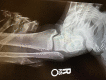
Figure
Acute Ankle Sprain Course 3 ankle sprain demonstrated past talar tilt test stress radiograph. Note the varus positioning of the talus on the tibia. Contributed past Marker A. Dreyer, DPM, FACFAS

Figure
Acute Ankle Sprain Deltoid and syndesmotic insufficiency demonstrated by medial gutter widening. Contributed by Marker A. Dreyer, DPM, FACFAS
References
- ane.
-
Chen ET, Borg-Stein J, McInnis KC. Talocrural joint Sprains: Evaluation, Rehabilitation, and Prevention. Curr Sports Med Rep. 2019 Jun;18(vi):217-223. [PubMed: 31385837]
- 2.
-
Al-Mohrej OA, Al-Kenani NS. Chronic ankle instability: Current perspectives. Avicenna J Med. 2016 Oct-December;6(4):103-108. [PMC free commodity: PMC5054646] [PubMed: 27843798]
- 3.
-
Pourkazemi F, Hiller CE, Raymond J, Black D, Nightingale EJ, Refshauge KM. Predictors of recurrent sprains after an index lateral ankle sprain: a longitudinal study. Physiotherapy. 2018 Dec;104(4):430-437. [PubMed: 29325691]
- 4.
-
Hung YJ. Neuromuscular control and rehabilitation of the unstable ankle. Globe J Orthop. 2015 Jun 18;6(5):434-viii. [PMC free article: PMC4458494] [PubMed: 26085985]
- 5.
-
Soboroff SH, Pappius EM, Komaroff AL. Benefits, risks, and costs of alternative approaches to the evaluation and handling of astringent ankle sprain. Clin Orthop Relat Res. 1984 Mar;(183):160-eight. [PubMed: 6421526]
- 6.
-
Waterman BR, Owens BD, Davey S, Zacchilli MA, Belmont PJ. The epidemiology of ankle sprains in the United states. J Bone Articulation Surg Am. 2010 October 06;92(13):2279-84. [PubMed: 20926721]
- seven.
-
Doherty C, Delahunt E, Caulfield B, Hertel J, Ryan J, Bleakley C. The incidence and prevalence of ankle sprain injury: a systematic review and meta-analysis of prospective epidemiological studies. Sports Med. 2014 Jan;44(one):123-forty. [PubMed: 24105612]
- viii.
-
Wahlstrom D, Collins P, White T, Luciana One thousand. Developmental changes in dopamine neurotransmission in adolescence: behavioral implications and issues in cess. Brain Cogn. 2010 February;72(1):146-59. [PMC free article: PMC2815132] [PubMed: 19944514]
- nine.
-
Waterman BR, Belmont PJ, Cameron KL, Deberardino TM, Owens BD. Epidemiology of talocrural joint sprain at the United States Military Academy. Am J Sports Med. 2010 Apr;38(4):797-803. [PubMed: 20145281]
- 10.
-
Beckenkamp PR, Lin CC, Macaskill P, Michaleff ZA, Maher CG, Moseley AM. Diagnostic accuracy of the Ottawa Ankle and Midfoot Rules: a systematic review with meta-assay. Br J Sports Med. 2017 Mar;51(vi):504-510. [PubMed: 27884861]
- 11.
-
Li Q, Zhang Z, Cai Z. Loftier-dose ketorolac affects adult spinal fusion: a meta-analysis of the result of perioperative nonsteroidal anti-inflammatory drugs on spinal fusion. Spine (Phila Pa 1976). 2011 April 01;36(seven):E461-8. [PubMed: 20489674]
- 12.
-
Postle One thousand, Pak D, Smith TO. Effectiveness of proprioceptive exercises for ankle ligament injury in adults: a systematic literature and meta-analysis. Man Ther. 2012 Aug;17(4):285-91. [PubMed: 22459604]
- 13.
-
Schiftan GS, Ross LA, Hahne AJ. The effectiveness of proprioceptive grooming in preventing ankle sprains in sporting populations: a systematic review and meta-analysis. J Sci Med Sport. 2015 May;eighteen(iii):238-44. [PubMed: 24831756]
- 14.
-
Vuurberg G, Hoorntje A, Flash LM, van der Doelen BFW, van den Bekerom MP, Dekker R, van Dijk CN, Krips R, Loogman MCM, Ridderikhof ML, Smithuis FF, Stufkens SAS, Verhagen EALM, de Bie RA, Kerkhoffs GMMJ. Diagnosis, treatment and prevention of ankle sprains: update of an evidence-based clinical guideline. Br J Sports Med. 2018 Aug;52(fifteen):956. [PubMed: 29514819]
- 15.
-
Janssen KW, van Mechelen W, Verhagen EA. Bracing superior to neuromuscular training for the prevention of self-reported recurrent ankle sprains: a iii-arm randomised controlled trial. Br J Sports Med. 2014 Aug;48(16):1235-9. [PMC free article: PMC4145426] [PubMed: 24398222]
- xvi.
-
Verhagen EA, Bay K. Optimising ankle sprain prevention: a disquisitional review and applied appraisal of the literature. Br J Sports Med. 2010 Dec;44(15):1082-eight. [PubMed: 21047837]
- 17.
-
Loren GJ, Ferkel RD. Arthroscopic assessment of occult intra-articular injury in acute ankle fractures. Arthroscopy. 2002 Apr;18(4):412-21. [PubMed: 11951201]
- 18.
-
van Dijk CN, Bossuyt PM, Marti RK. Medial ankle hurting after lateral ligament rupture. J Bone Articulation Surg Br. 1996 Jul;78(four):562-7. [PubMed: 8682821]
harriscrinver1946.blogspot.com
Source: https://www.ncbi.nlm.nih.gov/books/NBK560619/
0 Response to "Is a Sprained Ankle Likely to Happen Again"
Post a Comment