What organization did clara barton help to start
| Clara Barton | |
|---|---|
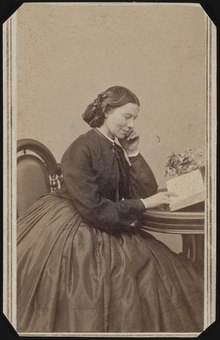 | |
| Born | Clarissa Harlowe Barton (1821-12-25)Dec 25, 1821 North Oxford, Massachusetts, U.S. |
| Died | April 12, 1912(1912-04-12) (aged 90) Glen Echo, Maryland, U.S. |
| Resting place | N Cemetery (Oxford, Massachusetts) |
| Occupation | Nurse, humanitarian, founder and beginning president of the American Scarlet Cross |
| Relatives | Elvira Stone (cousin) |
| Signature | |
 | |
Clarissa Harlowe Barton (December 25, 1821 – April 12, 1912) was an American nurse who founded the American Red Cross. She was a infirmary nurse in the American Civil War, a instructor, and a patent clerk. Since nursing education was not and then very formalized and she did not attend nursing school, she provided self-taught nursing care.[1] Barton is noteworthy for doing humanitarian work and civil rights advocacy at a time before women had the correct to vote.[2] She was inducted into the National Women'south Hall of Fame in 1973.[three]
Early life [edit]
Clarissa Harlowe Barton was born December 25, 1821, in Due north Oxford, Massachusetts, and was named after the titular character of Samuel Richardson's novel Clarissa. Her father was Captain Stephen Barton, a member of the local militia and a selectman (politico) who inspired his girl with patriotism and a broad humanitarian interest.[ii] He was a soldier under the command of General Anthony Wayne in his cause against the Indigenous in the northwest. He was likewise the leader of progressive thought in the Oxford village expanse.[4] Barton'due south mother was Sarah Stone Barton.
When she was three years old, Barton was sent to schoolhouse with her brother Stephen, where she excelled in reading and spelling. At school, she became close friends with Nancy Fitts; she is the only known friend Barton had every bit a child due to her farthermost timidity.[v]
When Barton was ten years sometime, she assigned herself the task of nursing her brother David back to wellness afterwards he fell from the roof of a barn and received a severe head injury. She learned how to distribute the prescribed medication to her brother, as well as how to place leeches on his body to bleed him (a standard treatment at the time). She continued to care for David long after doctors had given upward. He fabricated a full recovery.[5]
Her parents tried to help cure her timidity by enrolling her to Colonel Stones High School, but their strategy turned out to be a catastrophe.[half-dozen] Barton became more timid and depressed and would non eat. She was brought back home to regain her wellness.
Upon her render, her family unit relocated to aid a family unit member; a paternal cousin of Clara's had died and left his wife with four children and a farm. The house that the Barton family was to live in needed to be painted and repaired.[5] Clara was persistent in offering assist, much to the gratitude of her family unit. After the piece of work was done, she was at a loss considering there wasn't anything else to help with, to non feel similar a burden to her family.[half-dozen]
She began to play with her male child cousins and to their surprise, she was good at keeping upward with such activities as horseback riding. It wasn't until after she had injured herself that Clara'due south mother began to question her playing with the boys. Her mother decided she should focus on more than ladylike skills. She invited i of Clara'southward girl cousins over to help develop her femininity. From her cousin, she gained proper social skills as well.[7]
To aid Barton with overcoming her shyness, her parents persuaded her to become a schoolteacher.[8] She achieved her commencement teacher's certificate in 1839, at just 17 years quondam. This profession interested Barton greatly and helped motivate her; she ended up conducting an effective redistricting campaign that allowed the children of workers to receive an education. Successful projects such equally this gave Barton the confidence needed when she demanded equal pay for teaching.
Early on professional life [edit]
Barton became an educator in 1838 and served for 12 years in schools in Canada and West Georgia. Barton fared well as a teacher; she knew how to handle rambunctious children, particularly the boys since as a child she enjoyed her male child cousins' and brothers' company. She learned how to human activity like them, making it easier for her to relate to and control the boys in her intendance.[6] Later on her mother's death in 1851, the family dwelling closed down. Barton decided to further her education by pursuing writing and languages at the Clinton Liberal Constitute in New York. In this college, she adult many friendships that broadened her point of view on many issues concurring at the time. The main of the constitute recognized her tremendous abilities and admired her work. This friendship lasted for many years, somewhen turning into a romance.[4] As a writer, her terminology was pristine and like shooting fish in a barrel to understand. Her writings and bodies of work could instruct the local statesmen.[4]
While didactics in Hightstown, Barton learned almost the lack of public schools in Bordentown, the neighboring city.[4] In 1852, she was contracted to open a free school in Bordentown, which was the beginning ever free school in New Jersey.[9] She was successful, and subsequently a twelvemonth she had hired some other woman to help teach over 600 people. Both women were making $250 a year. This accomplishment compelled the town to raise near $four,000 for a new school building. Once completed, though, Barton was replaced equally master by a man elected by the school board. They saw the position equally head of a large institution to be unfitting for a adult female. She was demoted to "female banana" and worked in a harsh environment until she had a nervous breakdown along with other health ailments, and quit.[10]
In 1855, she moved to Washington D.C. and began work as a clerk in the U.s.a. Patent Office;[11] this was the start time a adult female had received a substantial clerkship in the federal government and at a salary equal to a man's salary. For iii years, she received much corruption and slander from male person clerks.[12] Subsequently, under political opposition to women working in government offices, her position was reduced to that of copyist, and in 1858, under the administration of James Buchanan, she was fired because of her "Black Republicanism".[12] After the ballot of Abraham Lincoln, having lived with relatives and friends in Massachusetts for three years, she returned to the patent office in the autumn of 1861, now as temporary copyist, in the hope she could make mode for more women in authorities service.
American Civil War [edit]

On April 19, 1861, the Baltimore Riot resulted in the first mortality of the American Civil War. The victims, members of the 6th Massachusetts Militia, were transported after the violence to the unfinished Capitol Building in Washington D.C., where Barton lived at the time. Wanting to serve her country, Barton went to the railroad station when the victims arrived and nursed forty men.[12] Barton provided crucial, personal help to the men in uniform, many of whom were wounded, hungry and without supplies other than what they carried on their backs. She personally took supplies to the edifice to help the soldiers.
Barton apace recognized them, equally she had grown upwards with some of them and even taught some. Barton, along with several other women, personally provided clothing, food, and supplies for the ill and wounded soldiers. She learned how to store and distribute medical supplies and offered emotional support to the soldiers by keeping their spirits high. She would read books to them, write letters to their families for them, talk to them, and support them.[13]
It was on that day that she identified herself with army piece of work and began her efforts towards collecting medical supplies for the Union soldiers. Prior to distributing provisions directly onto the battlefield and gaining further support, Barton used her ain living quarters as a storeroom and distributed supplies with the assist of a few friends in early on 1862, despite opposition in the War Department and amidst field surgeons.[two] Ladies' Assist Society helped in sending bandages, food, and clothing that would after be distributed during the Civil State of war. In Baronial 1862, Barton finally gained permission from Quartermaster Daniel Rucker to work on the forepart lines. She gained support from other people who believed in her cause. These people became her patrons, her most supportive being Senator Henry Wilson of Massachusetts.[xiv]
After the Beginning Boxing of Balderdash Run, Barton placed an ad in a Massachusetts paper for supplies; the response was a profound influx of supplies.[15] She worked to distribute stores, make clean field hospitals, utilise dressings, and serve food to wounded soldiers in close proximity to several battles, including Cedar Mountain, 2nd Balderdash Run, Antietam, and Fredericksburg.[16] Barton helped both Union and Confederate soldiers.[fifteen] Supplies were non always readily available though. At the battle of Antietam, for example, Barton used corn-husks in place of bandages.[17]
In 1863 she began a romantic human relationship with an officer, Colonel John J. Elwell.[18]
In 1864, she was appointed by Matrimony General Benjamin Butler every bit the "lady in charge" of the hospitals at the front of the Ground forces of the James. Among her more harrowing experiences was an incident in which a bullet tore through the sleeve of her dress without striking her and killed a homo to whom she was tending. She was known every bit the "Florence Nightingale of America".[19] She was besides known as the "Angel of the Battlefield"[13] afterwards she came to the aid of the overwhelmed surgeon on duty post-obit the battle of Cedar Mount in Northern Virginia in Baronial 1862. She arrived at a field hospital at midnight with a large number of supplies to help the severely wounded soldiers. This naming came from her frequent timely aid every bit she served troops at the battles of Fairfax Station, Chantilly, Harpers Ferry, South Mountain, Antietam, Fredericksburg, Charleston, Petersburg and Cold Harbor.[ix] [twenty]
Post American Civil War [edit]
After the finish of the American Civil War, Barton discovered that thousands of letters from distraught relatives to the War Department were going unanswered considering the soldiers they were asking about were cached in unmarked graves. Many of these soldiers were labeled as "missing". Motivated to exercise more about the state of affairs, Miss Barton contacted President Lincoln in hopes that she would be immune to answer officially to these unanswered inquiries. She was given permission, and "The Search for the Missing Men" commenced.[21]
After the war, she ran the Office of Missing Soldiers, at 437 ½ 7th Street, Northwest, Washington, D.C. in the Gallery Place neighborhood.[22] The function'south purpose was to discover or place soldiers killed or missing in action.[23] Barton and her assistants wrote 41,855 replies to inquiries and helped locate more than 22,000 missing men. Barton spent the summer of 1865 helping notice, identify, and properly bury 13,000 individuals who died in Andersonville prison military camp, a Confederate prisoner-of-war camp in Georgia.[24] She continued this task over the side by side 4 years, burying 20,000 more Union soldiers and marking their graves.[21] Congress eventually appropriated $fifteen,000 toward her project.[25]
American Red Cross [edit]

Barton achieved widespread recognition past delivering lectures around the country well-nigh her state of war experiences in 1865–1868. During this time she met Susan B. Anthony and began an association with the woman'southward suffrage movement. She also became acquainted with Frederick Douglass and became an activist for ceremonious rights. Afterwards her countrywide tour she was both mentally and physically exhausted and under md's orders to go somewhere that would take her far from her current work. She closed the Missing Soldiers Role in 1868 and traveled to Europe. In 1869, during her trip to Geneva, Switzerland, Barton was introduced to the Ruby-red Cantankerous and Dr. Appia; he later would invite her to be the representative for the American branch of the Red Cross and help her find financial benefactors for the commencement of the American Red Cantankerous. She was too introduced to Henry Dunant'southward book A Memory of Solferino, which called for the formation of national societies to provide relief voluntarily on a neutral basis.
In the beginning of the Franco-Prussian War, in 1870, she assisted the Grand Duchess of Baden in the preparation of military hospitals and gave the Red Cross club much aid during the war. At the joint asking of the High german authorities and the Strasbourg Comité de Secours, she superintended the supplying of piece of work to the poor of Strasbourg in 1871, later the Siege of Paris, and in 1871 had charge of the public distribution of supplies to the destitute people of Paris. At the close of the war, she received honorable decorations of the Golden Cross of Baden and the Prussian Fe Cantankerous.[26]
When Barton returned to the United States, she inaugurated a movement to proceeds recognition for the International Committee of the Red Cross (ICRC) by the United States authorities.[27] In 1873, she began work on this project. In 1878, she met with President Rutherford B. Hayes, who expressed the stance of most Americans at that time which was the U.S. would never once again face a calamity like the Civil War. Barton finally succeeded during the administration of President Chester Arthur, using the argument that the new American Red Cross could respond to crises other than state of war such equally natural disasters like earthquakes, forest fires, and hurricanes.
Barton became President of the American co-operative of the society, which held its first official coming together at her I Street apartment in Washington, DC, May 21, 1881. The first local society was founded Baronial 22, 1881 in Dansville, Livingston County, New York, where she maintained a country dwelling house.[28] [29]
The society's role inverse with the advent of the Castilian–American War during which it aided refugees and prisoners of the civil war. Once the Spanish–American War was over the grateful people of Santiago built a statue in honor of Barton in the town square, which still stands at that place today. In the United States, Barton was praised in numerous newspapers and reported about Red Cantankerous operations in person.[thirty]

Domestically in 1884 she helped in the floods on the Ohio river, provided Texas with food and supplies during the famine of 1887, took workers to Illinois in 1888 later a tornado, and that same year took workers to Florida for the yellow fever epidemic.[31] Within days later the Johnstown Flood in 1889, she led her delegation of 50 doctors and nurses in response.[31] In 1896, responding to the humanitarian crisis in the Ottoman Empire of the Hamidian massacres, Barton arrived in Constantinople February 15. Barton along with Minister Terrell spoke with Tewfik Pasha, the Turkish Minister of Foreign Affairs, to procure the right to enter the interior. Barton herself stayed in Constantinople to bear the business of the expedition. Her General Field Agent, J. B. Hubbell, M.D.; two Special Field Agents, Eastward. K. Wistar and C. K. Forest; and Ira Harris M. D., Medico in Charge of Medical Relief in Zeitoun and Marash, traveled to the Armenian provinces in the bound of 1896, providing relief and humanitarian aid to the Armenian population who were victims of the massacres washed in 1894-1896 past Ottoman Empire. Barton likewise worked in hospitals in Cuba in 1898 at the historic period of 77.[32] Barton's last field operation as President of the American Red Cantankerous was helping victims of the Galveston hurricane in 1900. The operation established an orphanage for children.
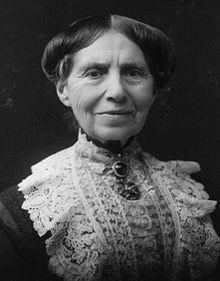
As criticism arose of her mixing professional and personal resources, Barton was forced to resign as president of the American Red Cross in 1904 at the age of 83 because her egocentric leadership style fit poorly into the formal structure of an organizational charity.[9] She had been forced out of office by a new generation of all-male scientific experts who reflected the realistic efficiency of the Progressive Era rather than her idealistic humanitarianism.[33] In retentivity of the courageous women of the civil war, the Blood-red Cross Headquarters was founded. During the dedication, non one person said a word. This was washed in lodge to honor the women and their services.[34] Afterwards resigning, Barton founded the National First Assist Society.
Final years [edit]
She continued to live in her Glen Echo, Maryland home which also served as the Ruddy Cross Headquarters upon her arrival to the firm in 1897. Barton published her autobiography in 1908, titled The Story of My Babyhood.[xx] On April 12, 1912, she died in her abode at the age of xc. The cause of death was pneumonia.
Religious beliefs [edit]
Although non formally a member of the Universalist Church building of America,[35] in a 1905 letter to the widow of Carl Norman Thrasher, she identified herself with her parents' church as a "Universalist".[36]
My honey friend and sister:
Your belief that I am a Universalist is every bit right as your greater belief that you lot are one yourself, a belief in which all who are privileged to possess it rejoice. In my case, it was a keen souvenir, like St. Paul, I "was born free", and saved the pain of reaching information technology through years of struggle and doubt.
My father was a leader in the building of the church in which Hosea Ballow preached his beginning dedication sermon. Your historic records will show that the old Huguenot town of Oxford, Mass. erected i of, if not the first Universalist Church in America. In this town I was born; in this church I was reared. In all its reconstructions and remodelings I have taken a part, and I await anxiously for a time in the well-nigh future when the busy world will allow me once more become a living role of its people, praising God for the advance in the liberal faith of the religions of the world today, so largely due to the teachings of this belief.
Requite, I pray you, beloved sis, my warmest congratulations to the members of your society. My best wishes for the success of your almanac meeting, and accept my thanks most sincerely for having written me.
Fraternally yours, (Signed) Clara Barton.
While she was not an active member of her parents' church, Barton wrote about how well known her family was in her hometown and how many relationships her male parent formed with others in their town through their church and organized religion.[6]
Clara Barton National Celebrated Site [edit]

In 1975, the Clara Barton National Historic Site, located at 5801 Oxford Route, Glen Echo, Maryland, was established equally a unit of the National Park Service at Barton's home, where she spent the terminal 15 years of her life. Equally the starting time National Historic Site dedicated to the accomplishments of a woman, it preserves the early history of the American Red Cross, since the habitation also served as an early headquarters of the organization.
The National Park Service has restored eleven rooms, including the Red Cross offices, the parlors, and Barton'southward sleeping accommodation. Visitors to Clara Barton National Historic Site tin gain a sense of how Barton lived and worked. Guides lead tourists through the three levels, emphasizing Barton's utilise of her unusual habitation. In 2018 the site was indefinitely closed due to repairs.[37]
The Northward Oxford, Massachusetts, house in which she was born is now likewise a museum.
Clara Barton's Missing Soldiers Part [edit]
In 1869, Barton airtight the Missing Soldiers Office and headed to Europe.[38] The third floor of her old boardinghouse was boarded up in 1913, and the site forgotten. The site was "lost" in part because Washington, DC realigned its addressing arrangement in the 1870s. The boardinghouse became 437 ½ Seventh Street Northwest (formerly 488-1/2 Seventh Street Westward).
In 1997, Full general Services Administration carpenter Richard Lyons was hired to check out the building for its sabotage. He constitute a treasure trove of Barton items in the attic, including signs, clothing, Civil War soldier's socks, an army tent, Civil War-era newspapers, and many documents relating to the Role of Missing Soldiers.[39] This discovery led to the NPS saving the edifice from demolition. It took years, withal, for the site to exist restored.[forty] The Clara Barton's Missing Soldiers Office Museum, run by the National Museum of Civil War Medicine, opened in 2015.[41] [42]
Fictional depictions [edit]
- Numbering All the Bones past Ann Rinaldi features Barton and Andersonville Prison, a Civil War prison with terrible weather condition.
- Angel of Mercy (MGM, 1939) is a biographical short pic directed by Edward L. Cahn, starring Sara Haden as Barton and Ann Rutherford every bit a woman whose brother'south death in a Civil State of war battle inspires her to bring together Barton in her work.[43]
- In the NBC TV serial Voyagers! (1982–1983), Phineas Bogg and Jeffrey Jones travel through time to make sure history proceeds correctly. In the episode "The Travels of Marco ... and Friends", season 1, episode 9, original airdate Dec 3, 1982, Phineas and Jeffrey rescue Barton (Patricia Donahue) from a burning wagon, merely she is on the verge of succumbing to smoke inhalation. Jeffrey (a young boy from 1982) applies oral fissure-to-mouth resuscitation (a technique unknown in Barton's time) and saves her life, thus enabling her to go on to plant the American Scarlet Cross.
- Mandy Moore plays Barton in an episode of Drunk History which features a summary of Barton's accomplishments during and after the Civil State of war as narrated past Amber Ruffin.
- America: The Motion Picture features a highly fictionalized version of Clara Barton every bit voiced past Megan Leahy.
- In the HBO series The Gilded Age (2022), Barton is played by Tony Award-nominated actress Linda Emond.
Places named for Clara Barton [edit]

Schools [edit]
- Clara Barton Elementary Schoolhouse in Levittown, Pennsylvania
- Barton Hall at Montclair State University in Upper Montclair, New Jersey
- Clara Barton Elementary on Del Amo Boulevard in Long Embankment, California
- Clara Barton Elementary Schoolhouse in Alton, Illinois
- Clara Barton Unproblematic Schoolhouse in Redmond, Washington
- Clara Barton Unproblematic Schoolhouse in Milwaukee, Wisconsin
- Clara Barton Elementary School in Anaheim, California
- Barton County Community Higher, Great Bend, Kansas
- Clara Barton Elementary School in The Bronx
- Clara Barton Elementary Schoolhouse in Blood-red Loma, New Jersey
- Clara Barton Simple Schoolhouse in Chicago
- Clara Barton Simple Schoolhouse in Corona, California
- Clara Barton Uncomplicated School in Oxford, Massachusetts
- Clara Barton Elementary School in San Diego (at present San Diego Cooperative Charter Schoolhouse)
- Clara Barton Elementary Schoolhouse in Rochester NY[44]
- Clara Barton Elementary School in West Mifflin, Pennsylvania
- Clara Barton Inferior High School in Royal Oak, Michigan
- Clara Barton High Schoolhouse for Wellness Professions in Brooklyn
- Clara Barton House, a residence hall at Towson University, Towson, Maryland
- Clara Barton Open School in Minneapolis
- Clara Barton School, in Cabin John, Maryland, at present the Clara Barton Community Center
- Clara Barton School in Bordentown, New Jersey
- Clara Barton Schoolhouse in Fargo, North Dakota
- Clara Barton School in Philadelphia
- Barton Academy in Mobile, Alabama
Streets [edit]
- Clara Barton Road in Oxford, Massachusetts
- Clara Barton Lane in Galveston, Texas
- Barton Boulevard in Rockledge, Florida
- Clara Barton Drive in Albany, New York
- Clara Barton Drive in Fairfax Station, Virginia
- Clara Barton Parkway in Maryland
- Clara Barton Street in Dansville, NY
- Clara Barton Boulevard in Garland, TX
- Clara Barton Circumvolve in Sylacauga, AL
- Clara Bartonstraat in Amsterdam
- Barton Road in Windsor, Maine
Other [edit]
- Barton, a crater on Venus
- Barton Center for Diabetes Education, N Oxford, Massachusetts
- Barton Canton, Kansas
- Barton Hall, Iowa Country University
- Barton House in Towson University
- Barton Towers, in Royal Oak, Michigan, on the old site of Clara Barton Junior Loftier Schoolhouse
- Barton's Crossing, Pittsfield, Massachusetts, a homeless shelter[45]
- Clara Barton, a Norwegian Air Boeing 737-8MAX (function of Norwegian's "Tailfin Heroes" series)
- Clara Barton, New Jersey, an unincorporated community located within Edison Township
- Clara Barton Auditorium, United States Patent and Trademark Office, Alexandria, Virginia
- Clara Barton Community Eye, Cabin John, Maryland
- Clara Barton District, a regional association of Unitarian Universalist Association fellow member congregations
- Clara Barton Starting time Aid Squad, Edison, New Bailiwick of jersey
- Clara Barton Home and Gardens, Johnstown, PA
- Clara Barton Hospital and Clinics, Hoisington, Kansas
- Clara Barton Memorial Woods in Lake Clear, New York, planted in 1925
- Clara Barton Post Role Building, at fourteen Walnut Street in Bordentown, New Jersey[46]
- Clara Barton Service Area, on the New Jersey Turnpike in Oldmans Township, New Bailiwick of jersey
- Clara Barton Shelter, Stony Brook State Park, Dansville, New York
- Clara Barton Tree, a behemothic sequoia tree in the Giant Wood, Sequoia National Park[47]
- Heritage of Clara Barton, Edison, NJ, an Assisted Living Community
- Lake Barton in Burke, Virginia
- The Business firm of Clara Barton at The King'south Higher (New York Metropolis)[48]
Other remembrances [edit]

Barton on a 1948 U.S. commemorative postage stamp.

A stamp with a portrait of Barton and an image of the American Cherry Cross symbol was issued in 1948.[49]
Barton was inducted into the National Women'due south Hall of Fame in 1973.[three]
Barton was featured in 1995 in a set up of U.S. stamps commemorating the Ceremonious War.[fifty] [51]
In 2019, Barton was announced as ane of the members of the inaugural class of the Government Executive magazine's Regime Hall of Fame.[52]
Exhibits in the due east wing of the third floor, 3 Eastward, of the National Museum of American History are focused on the U.s. at war. The Clara Barton Red Cantankerous ambulance was at 1 indicate the signature artifact in that location but is no longer on display.
The schoolhouse in the Disney show Sydney to the Max is named Clara Barton Eye School.
Published works [edit]
- Barton, Clara H. The Ruby-red Cross-In Peace and War. Washington, D.C.: American Historical Press, 1898. OCLC 1187508.
- Barton, Clara H. Story of the Cherry-red Cross-Glimpses of Field Work. New York: D. Appleton and Company, 1904. OCLC 5807882.
- Barton, Clara H. The Story of My Childhood. New York: Bakery & Taylor Company, 1907. Reprinted by Arno Printing in 1980. OCLC 6015444.
References [edit]
- ^ Summers, Cole. "Clara Barton- Founder of the American Red Cross". Truth About Nursing . Retrieved May 5, 2017.
- ^ a b c Edward, James; Wilson, Janet; Southward. Boyer, Paul (1971). Notable American Women 1607–1950: A Biographical Dictionary, Vol. one. Cambridge, MA: Belknap Pr. pp. 103–107.
- ^ a b "Barton, Clara". National Women'due south Hall of Fame.
- ^ a b c d Bacon-Foster, Corra (1918). "Clara Barton, Humanitarian". Records of the Columbia Historical Society, Washington, D.C. 21: 278–356. JSTOR 40067108.
- ^ a b c Barton, Clara (1980). The Story of My Childhood New York: Arno Press Inc
- ^ a b c d Pryor, Elizabeth Brown (1987). Clara Barton: Professional person Angel. Philadelphia: University of Pennsylvania Press. ISBN 0812212738
- ^ Pryor, Elizabeth Chocolate-brown (1988). Clara Barton: professional affections. Philadelphia: University of Pennsylvania. ISBN978-0-8122-1273-0.
- ^ Pryor, Elizabeth Brown (2000). "Barton, Clara". American National Biography
- ^ a b c Howard, Angela; Yard. Kavenik, Frances (1990). Handbook of American Women's History. Vol. 696. NY: Garland. pp. 61–62.
- ^ Spiegel, Allen D (1995). "The Function of Gender, Phrenology, Discrimination and Nervous Prostration in Clara Barton'due south Career". Journal of Customs Health. 20 (vi): 501–526. doi:x.1007/BF02277066. PMID 8568024. S2CID 189875392.
- ^ "Clara Barton", Dictionary of Unitarian & Universalist Biography
- ^ a b c Willard, Frances E.; Livermore, Mary A. (2005). Neat American Women of the 19th Century: A Biographical Encyclopedia. Amherst, NY: Humanity Books. pp. 81–82. ISBN9781591022114.
- ^ a b "Clara Barton | American Cerise Cross Founder | Who is Clara Barton". American Cherry-red Cantankerous . Retrieved December nine, 2016.
- ^ Oates, Stephen B. (1994). A Woman of Valor. Macmillan. pp. xiii, 51–52. ISBN0-02-923405-0.
- ^ a b Tsui, Bonnie (2006). She Went to the Field: Women Soldiers of the Ceremonious State of war. Guilford: Two Dot. p. 110. ISBN978-0-7627-4384-1.
- ^ Oates, Stephen B. (1994). A Adult female of Valor. Macmillan. pp. 58–64, 67–77, 83–91, 106–120. ISBN0-02-923405-0.
- ^ Hall, Richard H. (2006). Women on the Civil State of war Battlefront. Lawrence: University Printing of Kansas. p. 41. ISBN978-0-7006-1437-0.
- ^ Oates, Stephen B. (1994). A Adult female of Valor. Macmillan. pp. 145–146, 148–157. ISBN0-02-923405-0.
- ^ Barton, William Eleazar (1922). "The Forerunners of the Cherry-red Cross". The Life of Clara Barton: Founder of the American Ruddy Cross, Volume 2. Houghton Mifflin. p. 115. Retrieved February 4, 2019 – via Google Books.
- ^ a b "The Story of My Childhood". World Digital Library. 1907. Retrieved October 9, 2013.
- ^ a b Harper, Ida H. (1912). "The Life and Work of Clara Barton". The North American Review. 195 (678): 701–712. JSTOR 25119760.
- ^ Clara Barton Archived March v, 2016, at the Wayback Machine. dcwriters.poetrymutual.org
- ^ "Clara Barton Missing Soldiers Part". National Museum of Ceremonious War Medicine. Archived from the original on December 21, 2013. Retrieved June thirty, 2014.
- ^ "Clara Barton and Andersonville". National Park Service. Retrieved January 30, 2016.
- ^ Peck, Garrett (2015). Walt Whitman in Washington, D.C.: The Civil War and America's Cracking Poet. Charleston, SC: The History Press. pp. 76–79. ISBN978-1-62619-973-6.
- ^ One or more of the preceding sentences incorporates text from a publication at present in the public domain:Wilson, J. G.; Fiske, J., eds. (1900). . Appletons' Cyclopædia of American Biography. New York: D. Appleton.
- ^ Epler, Percy Harold (1915). The Life of Clara Barton. Macmillan. Retrieved September 28, 2010.
- ^ Marks, Mary Jo. "History – Founder Clara Barton". American Red Cross. Retrieved May 21, 2014.
- ^ McCullough, David (1968). The Johnstown Alluvion. New York: Simon & Schuster. p. 239. ISBN978-0-671-39530-8.
- ^ Dromi, Shai 1000. (2020). Above the fray: The Red Cross and the making of the humanitarian NGO sector. Chicago: Univ. of Chicago Press. pp. 102–106. ISBN9780226680101.
- ^ a b McCullough, David (1968). The Johnstown Flood. New York: Simon & Schuster. ISBN978-0-671-39530-8.
- ^ Ardalan, Christine (2010). "Clara Barton's 1898 battles in Cuba: a reexamination of her nursing contributions" (PDF). Florida Atlantic Comparative Studies Journal. 12 (1): ane–20.
- ^ Burton, David Henry (1995) Clara Barton: In the Service of Humanity. Greenwood.
- ^ Downing, Margaret Brent (1924). "The Centenary of Clara Barton and Recent Biographical Sketches of Her Life and Achievements". Records of the Columbia Historical Guild, Washington, D.C. 26: 121–8. JSTOR 40067384.
- ^ Miller, Russell E. (1979). The Larger Hope: The Outset Century of the Universalist Church in America 1770 – 1870. p. 124. ISBN9780933840003. OCLC 16690792.
Although not formally a Universalist by church membership, she had come of a Universalist family, was sympathetic to the tenets of the denomination, and has always been claimed past information technology.
- ^ "Positive Atheism website". Archived from the original on March 5, 2016. Retrieved May 25, 2007. Source taken from The Universalist Leader 120/49 1938.
- ^ "Clara Barton NHS – The House". National Park Service. Archived from the original on March 15, 2007. Retrieved May 25, 2007.
- ^ "Clara Barton Chronology 1861–1869". National Park Service. Retrieved June 8, 2015.
- ^ "Clara Barton'southward Missing Soldiers Office: An Historic Rediscovery on seventh Street". Smithsonian Assembly. July 2014. Retrieved September 23, 2015.
- ^ "Clara Barton'southward D.C. Part To Exist Civil War Missing Soldiers Museum". HuffPost. April 12, 2012. Retrieved September 23, 2015.
- ^ "Clara Barton Missing Soldiers Office". Retrieved June 12, 2017.
- ^ Peck, Garrett (2015). Walt Whitman in Washington, D.C.: The Ceremonious War and America's Great Poet. Charleston, SC: The History Press. pp. 76–80. ISBN978-ane-62619-973-six.
- ^ Affections of Mercy at IMDb
- ^ "Clara Barton School No. 2 / Overview". rcsdk12.org.
- ^ "Bartons Crossing Emergency (BCAC)". homelessshelterdirectory.org.
- ^ "Bill Declaration". whitehouse.gov – via National Athenaeum.
- ^ "Trail Map of Large Trees Trail". Retrieved December 22, 2015.
- ^ "Business firm of Clara Barton". Retrieved September 16, 2019.
- ^ 3c Clara Barton unmarried (due north.d.). "Arago: Clara Barton Issue". Arago.si.edu. Retrieved July vii, 2019.
- ^ "#2975 1995 32c Civil WarUsed Sheet". www.mysticstamp.com.
- ^ "1995 32c Civil War". www.mysticstamp.com.
- ^ Shoop, Tom. "Countdown Inductees into Government Hall of Fame Unveiled – Authorities Executive". Govexec.com. Retrieved August 16, 2019.
Further reading [edit]
- Barton, William East. The Life of Clara Barton Founder of the American Red Cross. (1922) OCLC 164624867.
- Burton, David Henry. Clara Barton: in the service of humanity (Greenwood, 1995); Major scholarly study online
- Crompton, Samuel Etinde. Clara Barton: Humanitarian. New York: Chelsea Firm, 2009. ISBN 978-one-60413-492-6. OCLC 290489234.
- Deady, Kathleen W. Clara Barton. Mankato: Capstone Press, 2003. ISBN 0-7368-1604-vi. OCLC 50022907.
- Dulles Foster R. The American Red Cross: A History (1950)
- Henle, Ellen Langenheim. "Clara Barton, Soldier or Pacifist?." Civil War History 24.2 (1978): 152–160. online
- Hutchinson, John F. Champions of Charity: State of war and the Rise of the Ruby-red Cross. Boulder: Westview Press, Inc., 1996. ISBN 0-8133-2526-9 OCLC 33948775.
- Jones, Marian Moser. The American Cerise Cantankerous from Clara Barton to the New Deal. Baltimore: Johns Hopkins University Printing, 2013. ISBN 978-ane-4214-0738-8 OCLC 786245443
- Joyce, James Avery. Cerise Cantankerous International and the Strategy of Peace. New York: Oceana Publications, Inc., 1959. OCLC 263367.
- Oates, Stephen B. A Adult female of Valor: Clara Barton and the Civil War. New York: Free Press, 1994. ISBN 0-02-923405-0 OCLC 29259364
- Ross, Ishbel. Angel of the Battlefield: The Life of Clara Barton. New York: Harper and Brothers Publishers, 1956. OCLC 420062.
- Safranski, Debby Burnett. Angel of Andersonville, Prince of Tahiti: The Boggling Life of Dorence Atwater. Alling-Porterfield Publishing House, 2008. ISBN 0-9749767-1-7 OCLC 613558868
- Holder, Victoria Fifty (October 2003). "From hand maiden to correct hand-the birth of nursing in America". Association of Operations Room Nurses. 78 (4): 618–32. doi:x.1016/S0001-2092(06)60669-viii. PMID 14575186. ProQuest 200782850.
- Barton, Study of Miss Clara 1896, Report, America'south Relief Expedition to Asia Small Under the Ruby-red Cantankerous. Journal Publishing Company, Meriden, Conn.
Historiography [edit]
- Amico, Eleanor B., ed. Reader's Guide to Women'southward Studies ( Fitzroy Dearborn, 1998) pg.56–57
External links [edit]
- Clara Barton, Civil State of war Nurse, Educator And Humanitarian
- Clara Barton Unproblematic Schoolhouse – Lake Washington School District
- Clara Barton National Historic Site
- Clara Barton Birthplace Museum
- Clara Barton Missing Soldiers Part
- The Barton Center For Diabetes Education, Inc.
- Clara Barton Passport Application – 1869 (Original document image)
- Clara Barton, A Register of Her Papers in the Library of Congress
- Clara Barton Papers at the Sophia Smith Collection, Smith College Special Collections
- Michals, Debra. "Clara Barton". National Women's History Museum. 2015.
- The personal papers of Clara Barton are in the Andover-Harvard Theological Library at Harvard Divinity School in Cambridge, Massachusetts.
- Works by Clara Barton at Project Gutenberg
- Works by or about Clara Barton at Internet Archive
- Works past Clara Barton at LibriVox (public domain audiobooks)

- Clara Barton at Find a Grave
- Portrait of Clara Barton on ICRC Library and Archives weblog CROSS-files
- Clara Barton papers at the University of Maryland Libraries
harriscrinver1946.blogspot.com
Source: https://en.wikipedia.org/wiki/Clara_Barton
0 Response to "What organization did clara barton help to start"
Post a Comment